You wing too many stages
Without a defined process for each stage, you are improvising under pressure and leaving money on the table every time.
For B2B and B2C salespeople who are done hitting quota by accident and ready to close with a repeatable, measurable process.

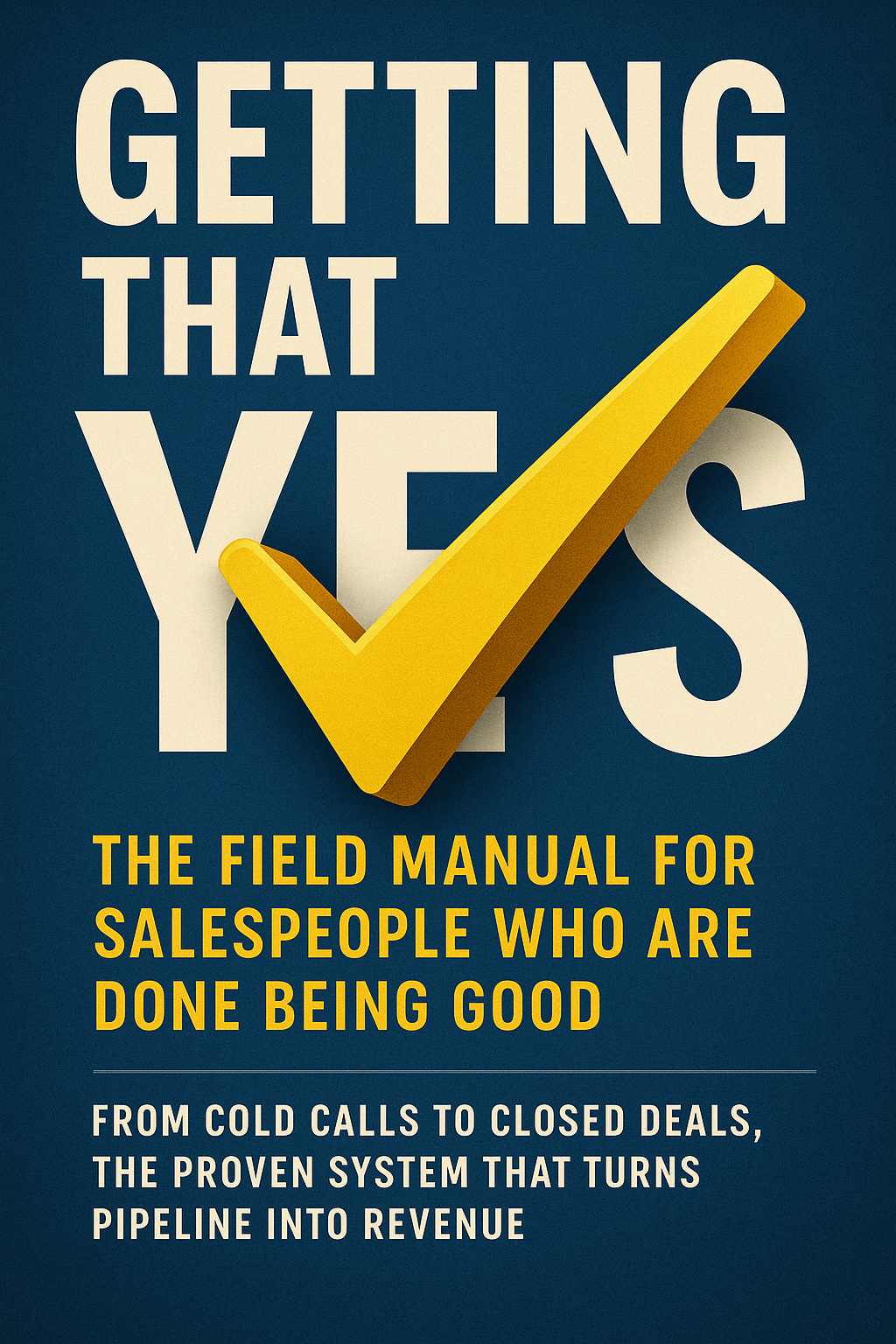
You can hold a conversation. You can demo the product. You have survived objections and occasionally even closed big deals. But your results are inconsistent, and you already know that inconsistency is just another word for a system you do not have yet. Scripts did not fix it. Training did not fix it. Here is what will.
Without a defined process for each stage, you are improvising under pressure and leaving money on the table every time.
You are spending time on prospects who were never going to buy, because you never built a filter that actually works.
When a deal falls apart, you cannot diagnose it because you never mapped what a healthy deal looks like at each stage.
This is not for beginners who need Sales 101. It is for salespeople who already know the basics and are frustrated that knowing the basics is not enough.
Each chapter targets a specific point of failure in the average salesperson's process and replaces it with something measurable and repeatable.
Build an ICP that stops wasting your calendar on people who were never going to convert.
Engineer a first contact that earns attention instead of earning a block.
Ask the questions that make a yes feel inevitable before you ever send a proposal.
Turn every no, not now, and maybe into a committed conversation that moves forward.
Present offers that are structured to survive the internal conversation your prospect has without you in the room.
Ask for the business directly, confidently, and without over-explaining yourself into a lost deal.
Turn every closed deal into the starting point for the next one.
The manual follows the exact arc of a deal from first contact to repeat business, so you can open it at any chapter and immediately apply it to wherever you are stuck right now.
Why the difference between inconsistent and elite is not talent or charisma but a documented, auditable process.
Stop chasing anyone who will take a meeting. Build a filter that surfaces buyers who are already primed to say yes.
Engineering a first contact that earns a response instead of landing in the voicemail graveyard.
The framework for uncovering real pain, real urgency, and real authority before you ever pitch anything.
A structured approach to every objection type so you stop improvising and start converting.
How to present your solution so it survives the internal conversation that happens after you leave the room.
Exactly how to ask for the sale, what to say in the silence that follows, and how to avoid talking yourself out of a done deal.
How to structure every closed deal so it generates the next one automatically.
The daily and weekly practices that compound your skills and results over a full career.
Every conversation you have with a prospect has inputs you can control and outputs you can measure. When a deal dies, there is a specific stage where it broke down. When a deal closes easily, there are specific things that happened earlier in the process that made it easy. This manual gives you the vocabulary, the frameworks, and the metrics to see your own sales process clearly, find exactly where you are losing, and fix it. Not by becoming a different person. By running a better system.
Both. The system is built around the psychology of buying decisions and the mechanics of a sales conversation, which apply whether you are selling software to a VP or a service to a homeowner.
Most sales books focus on mindset, personality, or a single technique. This guide treats every stage of the sales process as a repeatable engineering problem you can audit after every call.
No. The manual is written for salespeople with one to five years of experience who have the basics down but are hitting quota inconsistently. It meets you where you are.
It is a field manual, not a textbook. The writing is direct, the frameworks are practical, and every chapter is organized so you can read it before a call and apply something in that same conversation.
Because the goal is to get this into the hands of salespeople who need it. One closed deal you would have otherwise lost will return that investment many times over.
Instant digital access. Nine chapters. A complete, auditable system for every stage of the sale. No mindset fluff. No magic scripts. Just a process that works and can be measured.
A stage-by-stage field manual for salespeople who are tired of inconsistent results and ready to engineer every interaction into a predictable win.